Tea ceremony with a maiko or geiko
Ninety minutes in a room near Gojō Station: whisk your own matcha with two dry sweets, ask questions, take a photo, watch two dances and join a parlour game. Free cancellation up to eight days before.
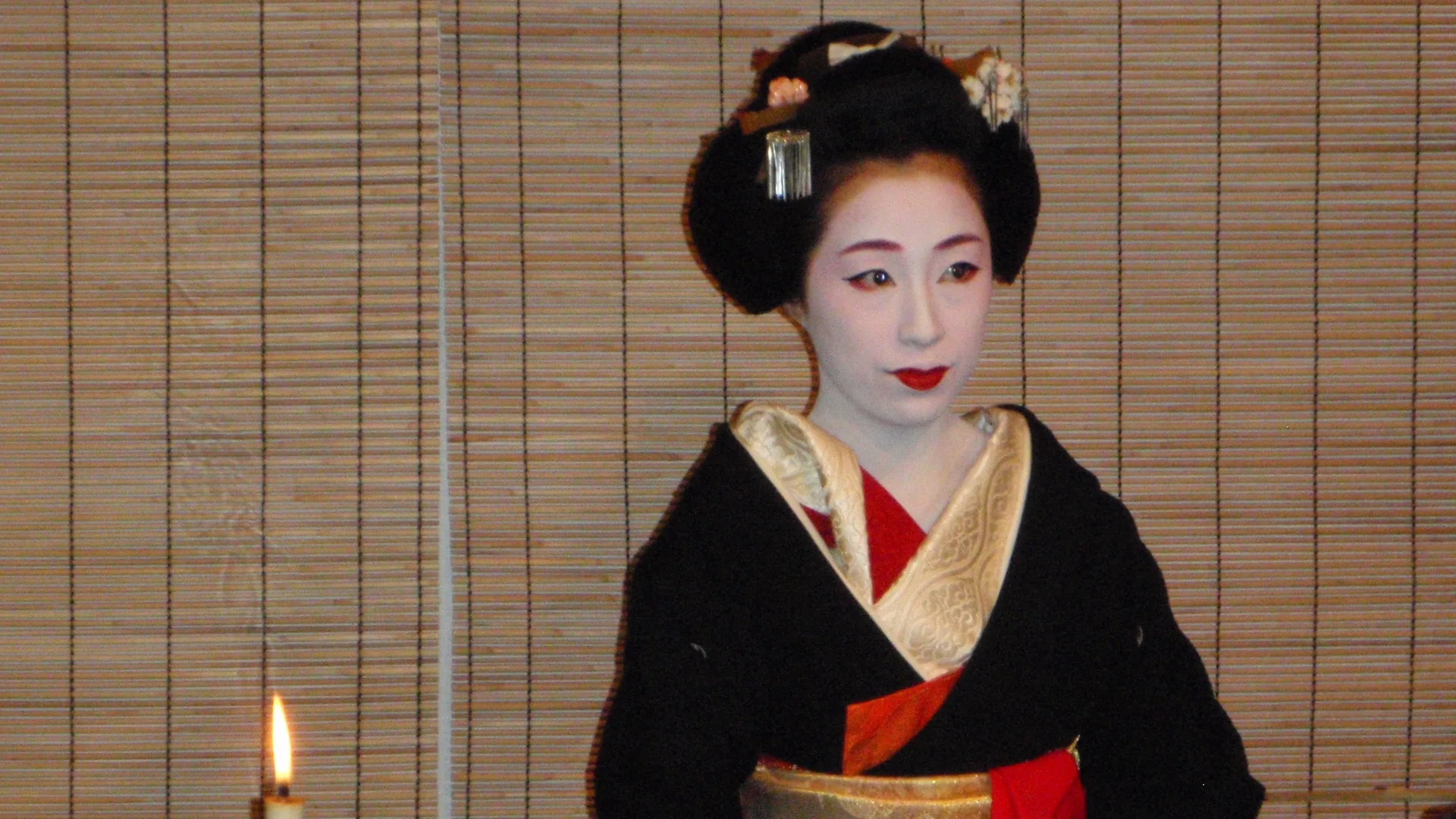
Gojō · Kyoto
A maiko or geiko leads a ninety-minute tea ceremony, dances twice, answers your questions and plays a parlour game.
Whether a maiko or a geiko hosts is decided on the day, never in advance.
Short verdict, then the detail
Yes, if what you want is to sit close to a maiko or geiko, make a bowl of matcha under her eye and hear her talk about her life, all inside ninety minutes. This is a hosted programme in a plain room in a building near Gojō Station, not a teahouse, and other diners may share the space. Book once your date is firm: cancelling is free only until eight days before, and moving the date counts as cancelling.
A tea ceremony led by a maiko or a geiko. She shows how matcha is made and you whisk your own bowl, with two dry sweets. Then come questions and answers, a photo beside her, a senjafuda paper slip as a gift, two short dances and a game with the guests.
Not an ochaya party, not a dinner and not a private audience. The host speaks Japanese, English translation is given as far as possible, the room sits above street level with stairs only, and nobody can tell you in advance whether a maiko or a geiko will come.
Ninety minutes in four lines
Her world, custom by custom
These are the customs of Kyoto's geisha world in general, drawn from encyclopedia articles, not the running order of this programme. Knowing them is the quickest way to better questions in the Q&A.
Hanamachi
Kyoto's geisha live and work in districts called hanamachi, or kagai in the local dialect: Gion Kōbu, Gion Higashi, Miyagawa-chō, Kamishichiken and Pontochō. Each district has its own crest, which appears on kimono and on lanterns.
Okiya
A maiko is affiliated with an okiya, a geisha house usually run by a woman its members call mother. The okiya books her engagements and her lessons in dance, music and tea, and an apprentice tends to borrow its kimono rather than own them.
Ochaya
An ochaya is a house where patrons are entertained by geisha. With very rare exceptions, only established patrons and the people they bring may enter.
Shikomi
Before her debut a girl may live in the okiya as a shikomi, learning to wear kimono, speak with guests and keep the house. Today this stage often lasts up to a year.
Minarai
Next comes minarai, a word meaning learning by observation. The trainee sits quietly at parties through one teahouse and watches her seniors talk, pour and play party games. The stage lasts only about a month.
Misedashi
At misedashi she becomes a maiko and is guided around her district to thank teachers and businesses. She wears a black trailing kimono with five crests and the wareshinobu, the hairstyle of a junior maiko.
Erikae
Around twenty or twenty-one a maiko becomes a geiko at erikae, a ceremony whose name means turning the collar. The red collar of her under-kimono gives way to the plain white collar a geiko wears.
Nihongami
Most Kyoto maiko style their own hair, which is redone every week, and sleep on a raised pillow called a takamakura to keep it in shape. Five hairstyles mark the stages of an apprenticeship.
Kanzashi
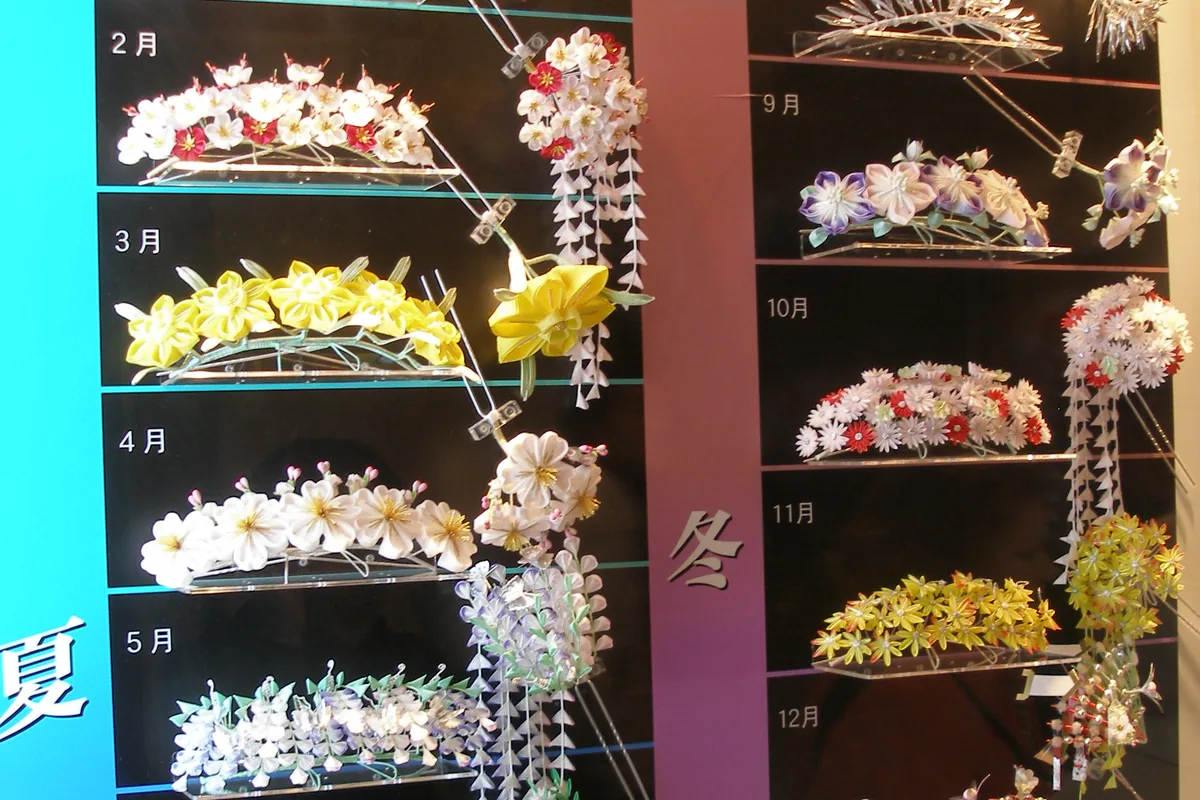
Maiko wear hana kanzashi, ornaments of folded silk flowers, and change them for each month of the year. The size, shape and number of ornaments also show how far along her training an apprentice is.
Darari obi
The darari obi is six to seven metres long and worn only by maiko, with her okiya's crest at one end. It is long and heavy enough that a male dresser, the otokoshi, ties it for her.
Buyō
Geisha dance grew from the dance of nō and kabuki theatre into a quieter, more stylised form, in which gestures carry the story. The shamisen, a three-string instrument plucked with a large plectrum, usually accompanies it.
Konpira
In konpira fune fune, a party game set to a folk song from Kagawa, two players take turns reaching towards a small object between them: an open hand if it is there, a fist if it has been lifted away. The wrong hand loses.
Senjafuda
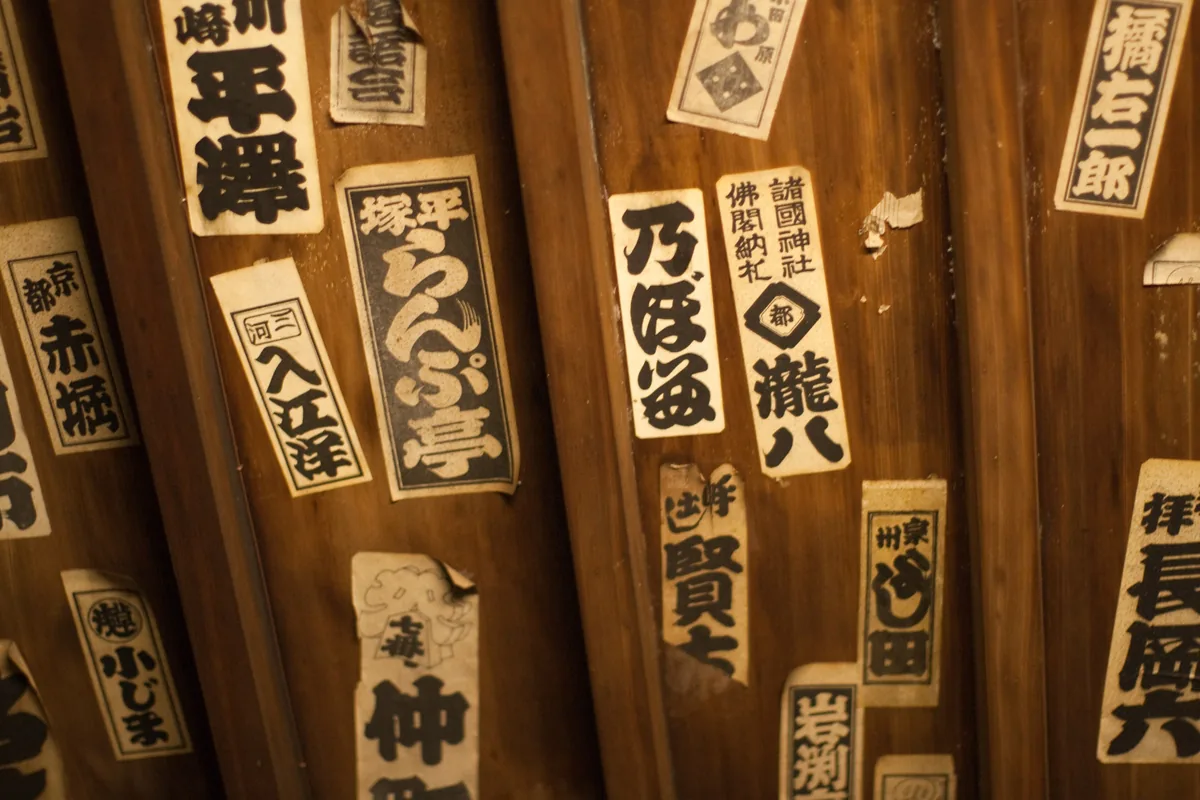
Senjafuda began as votive slips pasted on shrine and temple gates. In Kyoto's old pleasure quarters they turned into colourful name cards, and today that card-like use is the commonest one.
Sources: Wikipedia's articles on Maiko, Geisha, Hanamachi, Okiya, Ochaya, Misedashi, Kanzashi and Senjafuda, and the Japanese Wikipedia article on Konpira fune fune.
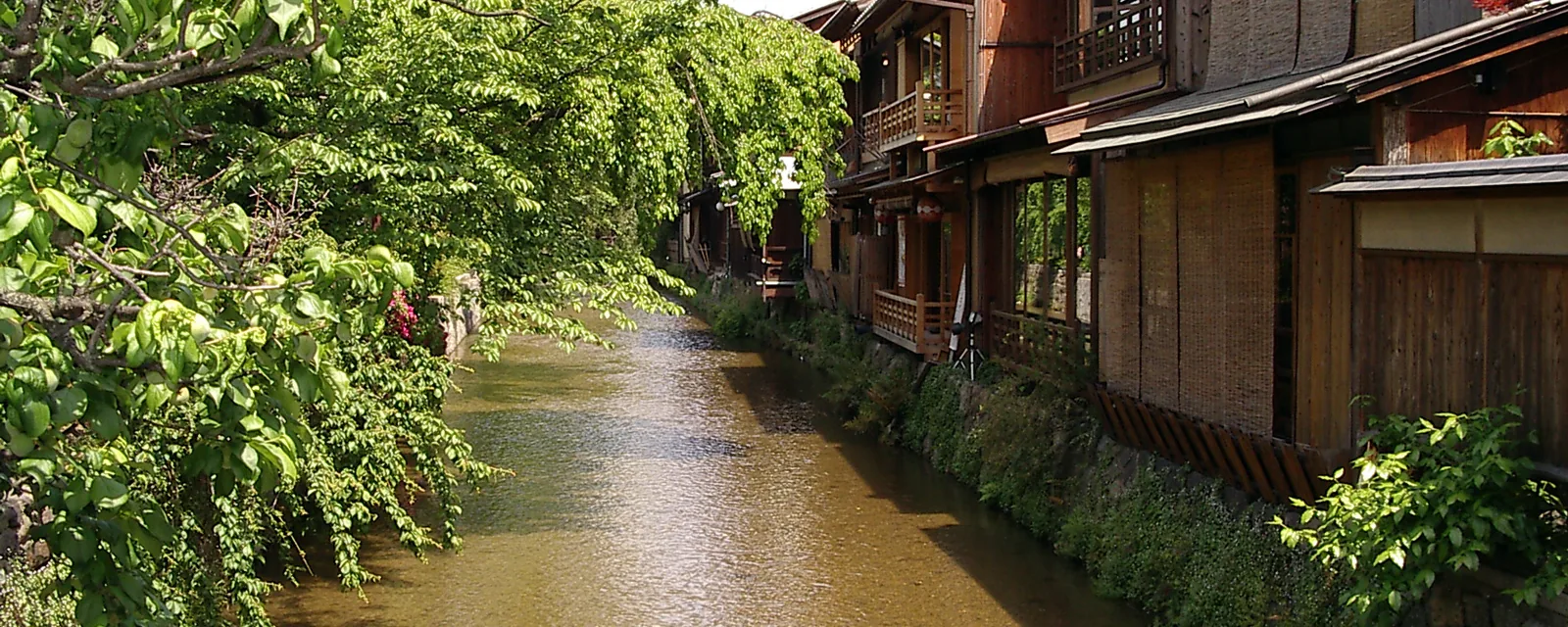
What the ninety minutes hold
Your confirmation gives the start time. These are the parts the ninety minutes include; the order on the day belongs to the host.
Arrive
The room is in a building a short walk from Exit 1 of Gojō Station, with its entrance on Gojō-dōri. There is no lift, and only people booked on the programme may enter, so a friend who isn't joining cannot wait inside.
Tea
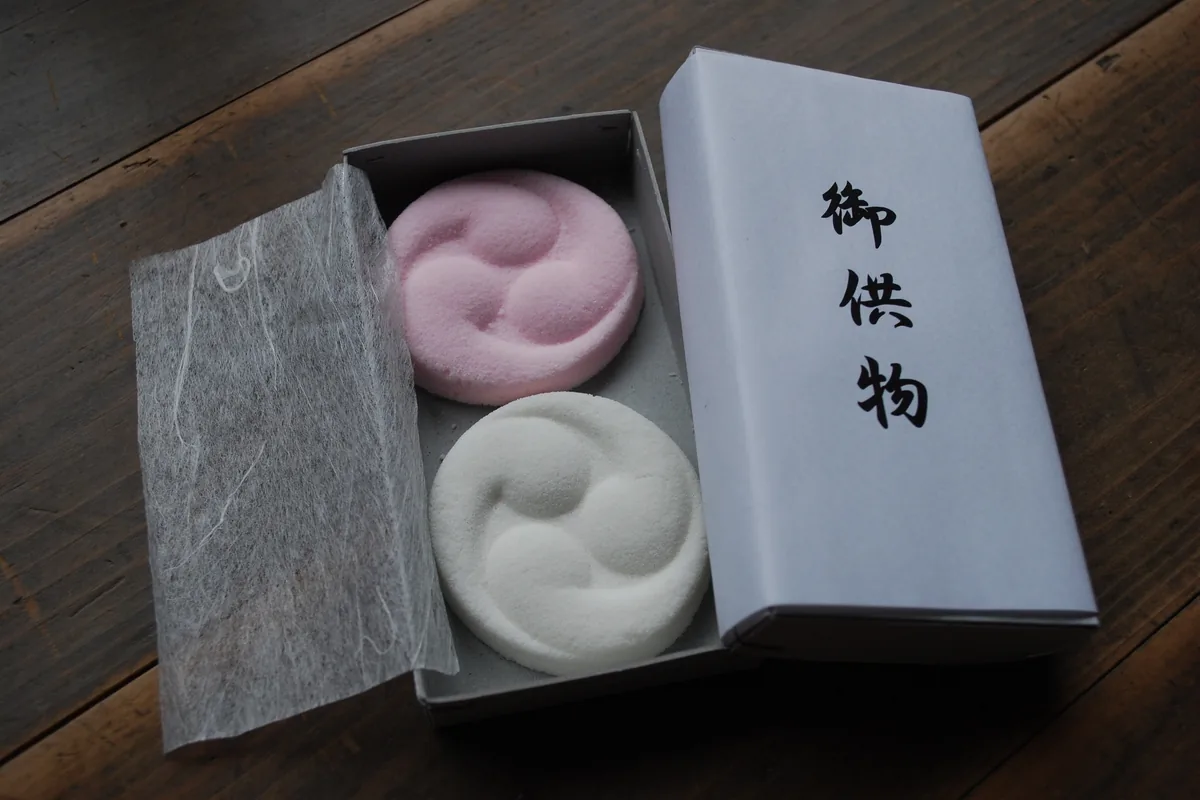
She shows how a bowl of matcha is made, then you make your own with a bamboo whisk. Two dry Japanese sweets come with it, the kind of confection traditionally served with thin tea.
Questions
The question-and-answer time is the heart of the programme: her day, her training, her kimono and hair. Answers come in Japanese and are put into English as far as possible.
Photo
You can take a commemorative photo beside her, and she presents a senjafuda, a small printed slip given as a lucky charm.
Dance
She performs two traditional dances that express the seasons of Japan, a love story or a scene of daily life. Seats in the front rows can be bought at the venue if you want to be nearer.
Game
A simple party game follows, with volunteers from the room. She leaves before the end, and the last part of the ninety minutes is time to chat and gather your things.
Paid for, extra and fine print
The ticket in plain words, so neither the room nor the rules catch you out.
Two ways into Kyoto's geisha world
Seen in Kyoto
Photographs of the tea, the hair ornaments and the streets the guides on this site describe.
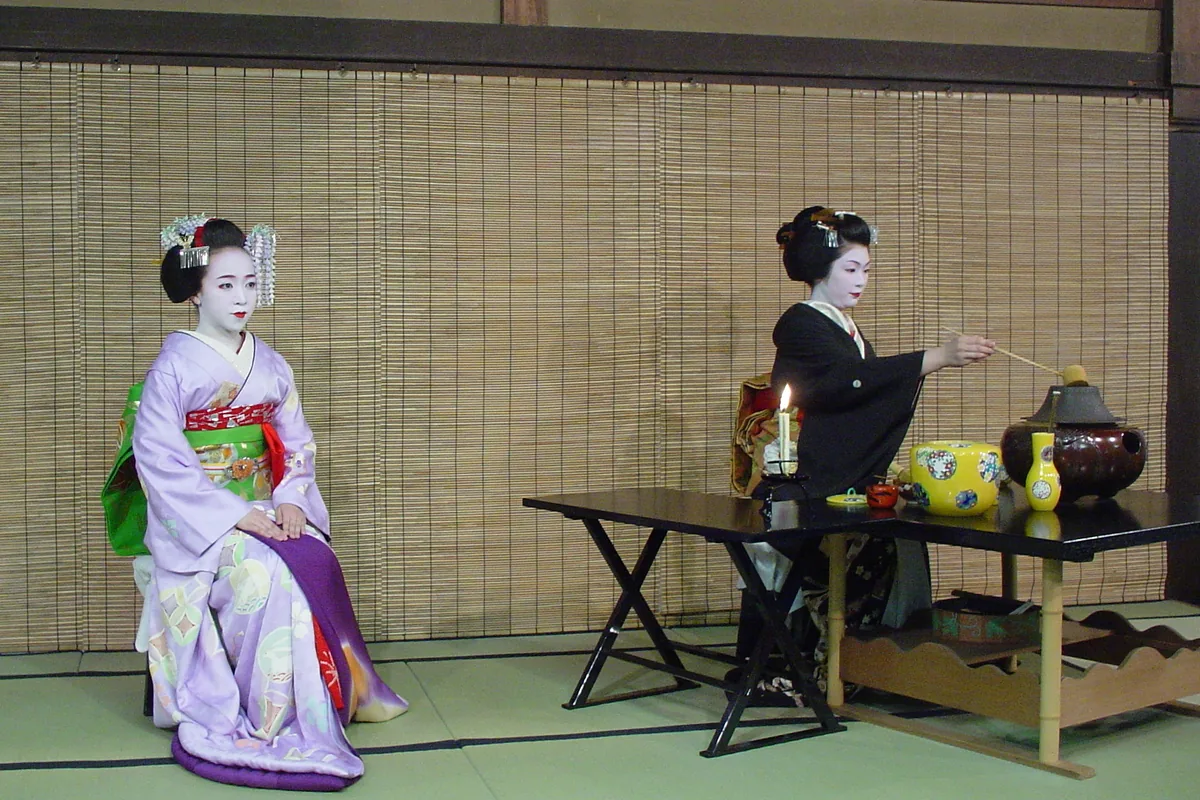
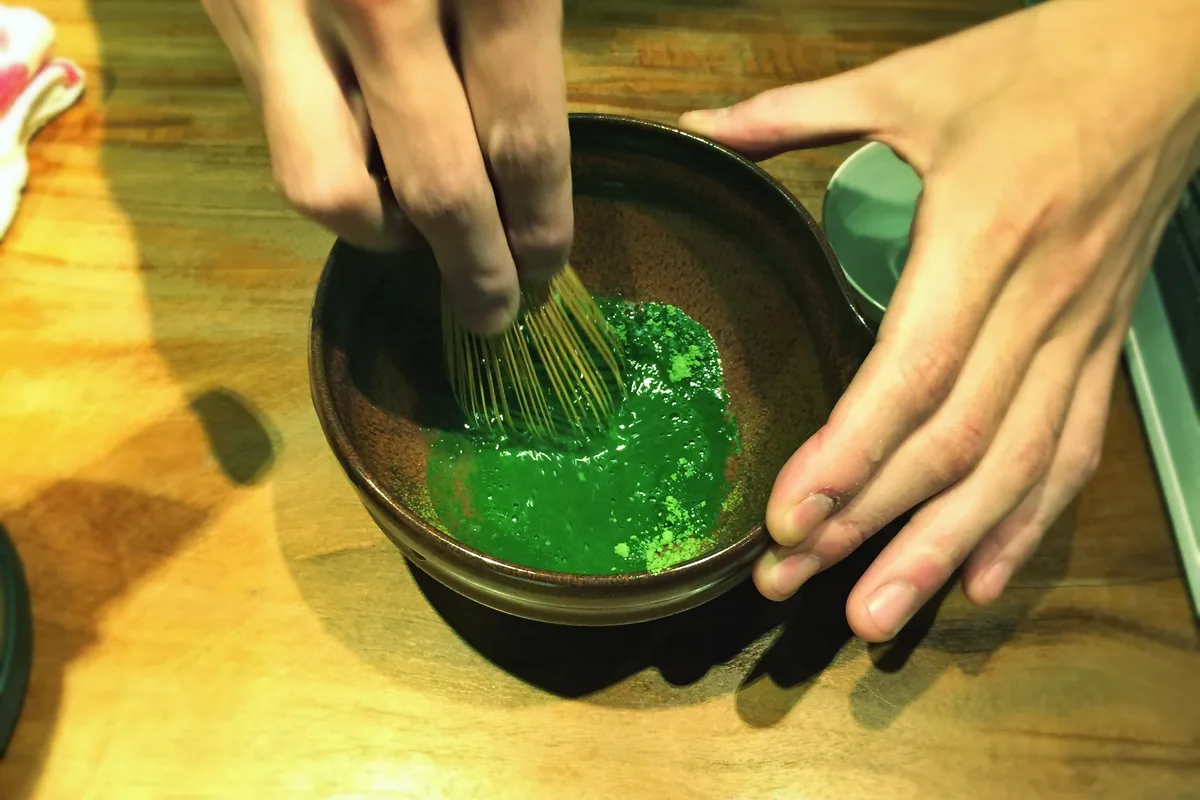
The tea, and three ways to fill the rest of the day
The tea ceremony is the reason you came. The other three cards cover Gion by afternoon or by night, and a full day of the temples further out.
Ninety minutes in a room near Gojō Station: whisk your own matcha with two dry sweets, ask questions, take a photo, watch two dances and join a parlour game. Free cancellation up to eight days before.
About two hours on foot from the Shirakawa through Gion with an English-speaking guide, past teahouses, temples and a pagoda, with a chance of glimpsing geiko or maiko on their way to work.
A two-hour evening walk for up to eight people through Gion and Higashiyama's lantern-lit lanes and shrines, with etiquette tips and a digital guide to Kyoto afterwards. Sightings are never promised.
A full day of eight and a half to nine hours from central Kyoto with an English-speaking guide and entry tickets, taking in Kiyomizu-dera, Arashiyama's bamboo, the Golden Pavilion and Fushimi Inari's gates.
More to book around Kyoto
Finding the venue
The venue is a short walk from Exit 1 of Gojō Station on the Karasuma Line of the Kyoto Municipal Subway, in Shimogyō ward. The entrance of the building faces Gojō-dōri, the main street.
The Karasuma Line connects with JR lines at Kyoto Station and with the Hankyu Kyoto Line at Shijō. Gojō carries the station number K10 on maps and signs.
Your confirmation shows the start time. Build in a few spare minutes for spotting the door on the main road and for the stairs, as the building has no lift.
Your booking on a charged phone, cash if you might want a seat upgrade or a snack, and two or three questions for her written down in advance.
If clear English matters to your group, ask the provider about the paid translation guarantee straight after you reserve rather than on the day.
The Gion walking tours in the cards above start in Gion, in Higashiyama ward. Check each meeting point before you plan a tea-then-walk afternoon.
Background before the tea
FAQ
Yes, if you want to meet a maiko or geiko up close in ninety minutes: you whisk your own matcha, ask her questions, take a photo and watch two dances. It is held in a plain room near Gojō Station, not a teahouse, and it is not a meal.
Either one. The provider brings in either a maiko or a geiko, chosen day by day, and cannot confirm in advance who will come. The programme is the same with either.
Cancelling is free up to eight days before your date when booked through GetYourGuide. After that there is no refund, and changing the date or the time counts as a cancellation, so book once your plans are fixed.
The host speaks Japanese and English translation is given as far as possible. If you need a guarantee of English translation, it is available for an extra fee by contacting the provider after you reserve.
No. The venue is a room in a building near Gojō Station, not an ochaya or a traditional house, and other guests having lunch or dinner may be in the room at the same time.
Two dry Japanese sweets come with the matcha you whisk. There is no meal. A snack can be bought at the venue.
No. Seats in the first, second and third rows can be bought as an optional upgrade at the venue. Everyone else sees the same programme from further back.
There is no lift, and each room is reached by stairs. Anyone who struggles with steps should message the provider through GetYourGuide before paying.
Yes. Children under two who sit on a parent's lap go free. Only people booked on the programme may enter, so a parent who is not joining cannot wait in the room.
No. This is an independent visitors' guide. Neither the venue nor the activity provider runs it, and it has no affiliation with either; you book through GetYourGuide.