Compare
Maiko tea or a Gion walk?
Tea with a maiko near Gojō or a guided walk through Gion: what each gives you, how long they take, the language, the cancellation terms and who each suits.
Choose a date for the tea ceremony ↗Quick answer
Choose the tea ceremony if meeting a maiko or geiko is the point: she hosts the ninety minutes, shows you how to whisk matcha, answers questions and dances twice, though in a plain room near Gojō Station. Choose the Gion walk if you want the district itself, its teahouses, canal and temples, explained in English over about two hours, with only a chance of seeing a maiko. The walk is cheaper and easier to cancel. Plenty of visitors book both for the same day.
The two side by side
| Maiko tea | Gion walk | |
|---|---|---|
| Length | About 90 min | About 2 hours |
| Maiko or geiko | Hosts the session | Possible glimpse |
| Setting | Room near Gojō | Gion's streets |
| Language | Japanese, translated | English guide |
| Cancelling | 8 days ahead | 24 hours ahead |
The short answer
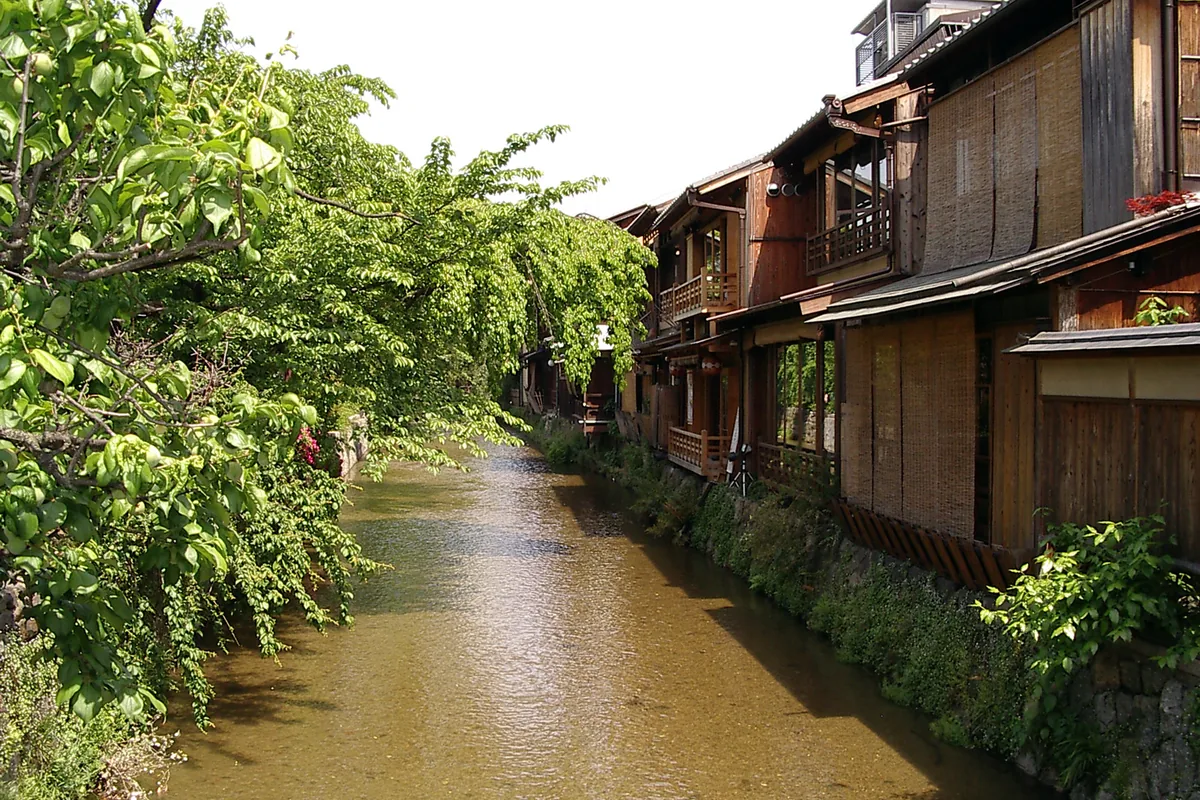
These two bookings answer different wishes, so start with yours. If you want to sit with a maiko or geiko, hear her voice and watch her dance, only the tea ceremony promises that, because she is the host. If you want to understand where Kyoto's geisha live and work, and to walk the lanes of Gion with someone who can explain them, the walking tour is the better buy. The walk cannot promise a sighting; the tea ceremony cannot offer the atmosphere of the district, since it is held in a room near Gojō Station.
What each one is
The tea ceremony is a seated programme of about ninety minutes led by a maiko or a geiko: she shows how matcha is made and you whisk your own, then comes a Q&A, a photo, a senjafuda gift, two dances and a party game. The Gion walking tour is about two hours of walking led by a guide who speaks English, starting by the Shirakawa in Gion and passing teahouses, Hōkan-ji's pagoda, Kennin-ji and Chion-in, with stories about the district and the history of geisha culture along the way. Both are booked through GetYourGuide and confirmed with a start time.
Meeting a maiko, or glimpsing one
This is the real dividing line. On the tea ceremony a maiko or geiko is in the room for most of the programme and talks to you directly. On a walk, maiko and geiko may pass on their way to evening engagements, and the tours describe this as an opportunity, not a promise; the small-group night tour states plainly that sightings can never be guaranteed. Be aware, too, that Gion has dressing studios that turn visitors into maiko for photos. By law in Kyoto these visitors must be dressed inaccurately, so the figure you photograph may not be an apprentice at all.
If you choose the night walk
The small-group night walk is a different flavour of the same idea. It is limited to eight guests, runs for about two hours through Gion and Higashiyama, and passes Yasaka Shrine, the Ninenzaka slope, Hōkan-ji and the Yasui Konpira-gū shrine. Its guides deliberately avoid the busiest geisha-spotting corners to reduce disruption to residents, share etiquette tips on photography and shrines, and send a digital guide to Kyoto afterwards. If you dislike crowds, it is the gentler of the two walks.
Where you spend the time
Gion, in Higashiyama ward, began as an entertainment quarter facing Yasaka Shrine and became one of the best-known geisha districts in Japan. It holds two of Kyoto's five hanamachi, Gion Kōbu and Gion Higashi, and preserves machiya townhouses, some of which serve as ochaya. Hanami Lane and the Shirakawa are among its preserved streets. The walk keeps you outdoors among those streets. The tea ceremony keeps you indoors in a plain room in a building a short walk from Gojō Station, which is a long way from the look of Gion but has its own advantage: chairs, a roof and no crowds.
Language
The walking tours are guided in English; the small-group night walk is offered in English and French. On the tea ceremony the host speaks Japanese and English translation is provided as far as possible, with a paid translation guarantee available if you contact the provider after reserving. If your group has limited patience for translation, that tilts towards the walk. If you would rather hear a maiko's own answers, even through an interpreter, it tilts the other way. Either way, short questions travel best.
Time of day
The Gion walk runs as an afternoon, evening or night tour, and the night walk is an evening affair by design. Gion's lanes are lit by lanterns after dark, which is when many visitors most want to be there. The tea ceremony's start times appear in the booking calendar for each date. Because the two last about ninety minutes and two hours, they combine well: tea in the afternoon, then a walk as the lanterns come on. Allow travelling time between Gojō and the Gion meeting point and check both start times before you book either. Either order works, but tea first leaves the evening free for the lanterns.
Cancellation and money
The terms differ sharply. The Gion walks cost nothing to cancel until 24 hours ahead, and you can reserve them now and pay later. The tea ceremony can be cancelled free only up to eight days before, and a change of date counts as a cancellation. The walk also costs less per person, while the tea ceremony sells optional front-row seat upgrades and a snack at the venue. If your plans in Kyoto are still loose, book the walk first and add the tea once the day is fixed.
Manners in Gion
Gion is not a stage set but a working district where geiko and maiko travel to lessons and engagements, and the night tour asks its guests to watch any passing maiko respectfully and from a distance. Whatever you book, do not block a maiko's path or chase her for a photo. On the tea ceremony the photo is part of the programme, which is one reason many visitors keep their camera for that session and simply enjoy the lanes on the walk.
Group size and children
The large-group Gion walk takes up to twenty people, and children aged six and under join it free of charge. The night walk is limited to eight guests, or runs privately for up to three. The tea ceremony lets children under two on a parent's lap in free; older children pay, and only people booked on the programme may enter the room. Families with toddlers usually find the outdoor walk easier, as long as everyone is happy on their feet for two hours. On the tea ceremony, the nearest seats are the first three rows, sold as upgrades at the venue.
Who each isn't for
The tea ceremony is not for anyone who cannot manage stairs, since the building has no lift, nor for travellers whose dates may move inside a week. The large Gion walk is unsuited to wheelchairs and to anyone with limited mobility, and it runs in all weather, so a wet evening means umbrellas. Neither one is a dinner. If what you really want is food with geisha entertainment, neither booking delivers it. For a single day, tea in the afternoon and Gion after dark is the pairing that shows you both the person and the place, while the full-day coach tour to the temples is better kept for another day.
Read next: Tea with a maiko: worth it?
Frequently asked questions
Which is better for meeting a maiko?
The tea ceremony. A maiko or geiko hosts it and talks with guests directly, while on a Gion walk any sighting is a matter of luck and never promised.
Which is better for seeing Gion?
The walking tour. The tea ceremony is held in a room near Gojō Station, outside the geisha districts, so you see nothing of Gion's streets.
Can I fit both into one day?
Yes. Tea in the afternoon and a Gion walk in the evening fit together well. Compare the two start times and leave room for the trip from Gojō to the walk's meeting point.
Which is easier to cancel?
The Gion walks, free to cancel until 24 hours ahead. The tea ceremony's free cancellation ends eight days before your date.
Which suits young children?
Usually the walk, where children aged six and under go free. On the tea ceremony only under-twos on a lap go free, and the room can only be reached by stairs.
Is either one a dinner?
No. The tea ceremony serves matcha with two dry sweets, and the walks include no food or drink.
Sources